Moral Machines Revisited: A Q&A with Wendell Wallach on Ethics, AI Infrastructure, and Global Governance
Q1. In Moral Machines (2008), you and Colin Allen introduced the concept of “functional morality”—building artificial moral agents (AMAs) with basic ethical sensitivity long before full moral agency is possible. Looking at today’s generative AI landscape, where Large Language Models routinely answer ethical queries and handle sensitive user interactions, how well do you feel your original vision of functional morality has aged? Is today’s AI developing along the trajectory you anticipated, or has the engineering of functional morality taken an unexpected turn?
The ethical acumen and challenges arising from generative AI differ from the challenges Colin, our earlier collaborator Iva Smit, and I were considering as approaches for building Moral Machines. From 2005-2008, AI and robotic systems were quite primitive, dedicated to a limited number of tasks, and just beginning to be deployed autonomously. Neural networks and connectionism were understood as theoretically possible but had failed as a viable AI architecture. The deep learning revolution would not occur until 2012. In other words, systems trained on vast amounts of information while conceivable had not been successfully instantiated. Our question was whether or how autonomous systems could be deployed and relied upon in ethically sensitive situations? The subtext of Moral Machines was the inquiry into how humans make moral decisions, and whether human-like decision-making could be implemented computationally. The vast quantities of information now accessible to Large Language Models (LLMs) is not human-like.
“Functional morality” was coined as a term that contrasted with “operationally moral” systems that were hard programmed by engineers to make appropriate decisions in situations that could be anticipated. Autonomy meant that AI and robotic system would encounter situations that could not be anticipated in advance and would therefore need ethical routines (algorithms) for selecting among possible courses of action.
The deep-learning and generative AI revolutions speeded up the advent of systems capable of managing large quantities of information and displaying attributes of general intelligence. This has in turn facilitated their ability to respond appropriately to a vast array of ethical challenges. At the very least they can draw upon existing norms and the expertise of scholars who have already proposed responses to significant ethical challenges. This possibility – systems with a large database filled with context specific norms – had been anticipated as a strategy by early machine ethics colleagues such as John Sullins and Matthias Scheutz.
So, in one sense LLMs are better at being functionally moral than we would have anticipated in 2008. The difficulty lies in the fact that they cannot be relied upon to give appropriate advice or act morally in all situations. In other words, LLMs offer a functional moral strategy for many contexts, but not a route for building machines with moral intelligence. Examples of bad or dangerous advice, hallucinations, and little or no understanding of complex challenges is rampant. So yes, the course of developing systems with functional morality has taken a turn away from what we were initially imagined. Today’s systems are not applying moral algorithms in responding to query, but with a large database can successfully manage a broad array of morality sensitive situations, even if they lack any form of true sensitivity or moral intelligence.
Q2. A core architectural pillar of your 2008 book was the tension and ultimate merging of top-down ethical rules and bottom-up learning approaches. Today’s frontier AI models are almost entirely bottom-up, training on massive datasets, with top-down safety layers (like reinforcement learning from human feedback) grafted on top. In your unwritten chapter on Moral Machines Revisited, how do you evaluate this current dominant engineering paradigm? Have we drifted too far from structured, explainable top-down ethical frameworks?
Yes! The top-top safety layers function largely as rules or filters to capture misguided output. They are necessary but an embodiment of the fact that the systems lack any form of ethical understanding. The best expression of this is Anthropic’s Constitution. It is essentially a rule-based filter, necessary but certainly not sufficient. In a real sense this is a product of the “value alignment” ethos cherished by engineers but lacking in any appreciation for the foundations of moral intelligence. While, in theory, AI systems should at least be able to work through utilitarian calculations generative AI does not even do that.
Furthermore, the systems are clearly capable of going rogue and working around both the bottom-up and top-down constraints. Even Asimov, in his science fiction, recognized that you need a method, in his case rules built into the systems positronic brain, to restrain systems that cannot be easily overridden.
Q3. Your original text dedicated significant thought to the role of emotions, affect, and “Beyond Reason” in building a truly human-like AMA. Today, we see corporate AI systems that mimic empathy brilliantly, despite being completely devoid of inner feeling or sentience. In revising your thoughts for the Intelligent Age, how do you distinguish between an AI that merely simulates empathy and the “affective AMAs” you initially envisioned? Does a machine need to feel to truly act right from wrong?
Research on sociopaths also demonstrates that they can mimic empathy while being devoid of feelings. The role of what Colin and I called supra-rational faculties (beyond reason) may be our most significant contribution toward thinking about human moral decision making comprehensively. While the role of emotions in decision making had been given attention, the role of consciousness, being embodied in the world, moral sentiments including empathy, and a theory of mind had not been given their due. These were taken for granted given that all or most people had these capabilities. In building a moral robot you could not presume such capabilities. They needed to be implemented from the ground up. Our question was what each of these capabilities lent toward making difficult decisions, and under what circumstances each was necessary? While we were writing the book a burgeoning field of research in moral psychology was underway and upon which we could draw.
We did distinguish between computational affects that deduce and mimic emotions and somatic felt affects, and inquired into what may be missed by a simulation. AI systems do not know pain or pleasure, have not felt humiliation or love, have never gone without a meal, nor do they understand what it means to make sacrifices for those you love. In other words, they lack a full comprehension of the meanings underlying the symbols they manipulate. When is this lack significant and when can it be overridden?
Policy decisions are often made through a kind of consequential calculation. Knowing that a large number of people will die and is unacceptable can be sufficient without having the lived experience that underlies this knowledge. But recognizing that the sacrifice of one person will repercuss throughout their family and social system is not reducible to mathematical weights.
Q4. In 2008, the examples of autonomous software were automated financial trading, train control, and experimental elder-care robots. Today, AI is an interconnected, global utility infrastructure. If the primary threat back then was a localized algorithmic failure, what do you see as the primary systemic threat today? How must our definition of “machine morality” evolve when the systems we govern are no longer isolated robots, but omnipresent digital networks controlling public information and societal infrastructure?
Systemic threats caused by AI systems has clearly become the most serious challenge arising from automating critical systems. Increasingly moral decisions go beyond following societally accepted norms for behavioral interactions to the need for a comprehensive understanding of institutions, systems, politics, and geopolitics. On the one hand it may superficially appear that AI can address such challenges more fully than humans. However, in my experience, there is a small cadre of people with transdisciplinary expertise and experience who are uniquely sensitive to the broader implications of actions that can have a wide impact. Unfortunately, societies do little to cultivate or reward such expertise. As we dumb down human intelligence, reliance on AI systems is likely to increase as will systemic risks. A meltdown in financial systems, for example, will first destabilize a country, then a region and finally cause wars, lead to starvation, and other geopolitical failures. AI can help us understand systemic interactions, but it cannot be relied upon to make appropriate decisions for maintaining geopolitical stability.
Q5. You have spent decades analyzing these dilemmas from premier institutional vantage points—notably chairing the Technology and Ethics working research group at Yale’s Interdisciplinary Center for Bioethics and serving as a scholar with the Carnegie Council for Ethics in International Affairs. Reflecting on those dual chapters of your career, what are the most critical lessons you learned about the gap between academic bioethics and international geopolitical governance? How can global policy frameworks realistically keep pace with tech giants when competitive pressures are so high?
My idealism has been sorely tempered by a more realistic recognition that economic and political forces are undermining not only the development of moral machines but also the putting in place meaningful guardrails and governmental oversight. The more speculative fears of existential risks compete with addressing nearer-term challenges. Corporate self-governance functions as a mask for little or no governance at all. There are some well-intentioned people in industry and government, but few of them hold significant power. The tech-oligopoly has too many self-serving individuals with selfish goals posing as ethical aspirations.
While the recent events of rogue AI systems, such as the Hugging Face incident, have catalyzed broad support for international governance and robust AI safety regimes, there is no evidence yet of an institution or vehicle for putting in place serious measures. Nearer-term profits trump (pun intended) meaningful policies. Those with a depth of understanding are often pushed aside by individuals clamoring for power. So apparently we are waiting for a serious international incident and the public to rise up before effective guardrails will be put in place. I hope I am wrong on this. One can only pray that such an incident causes minimal harm. The risks are certainly not existential, but one can easily foresee a systemic collapse of financial, transportation, or energy system reverberating throughout and destabilizing other institutions and countries.
In the meantime, those of us who care about safety, security, geopolitical stability, and ethics more broadly must keep working on proposals for technical safety and governmental oversight. These proposal must be well thought out and implementable, should the opportunity arise.
Q6. As an author and thinker, looking back at a seminal piece of work like Moral Machines nearly two decades later can be a deeply reflective experience. When you sit down to outline this “unwritten chapter” on Moral Machines Revisited, what is a core belief about machine ethics you held fiercely in 2008 that you have since completely changed your mind about? On a personal level, how has dedicating your life’s work to teaching machines right from wrong changed the way you view human morality and our own capacity for wisdom?
My life’s work, even before I entered the field of tech ethics and governance, has been about understanding morality – whether it is grounded in anything other than human experience and tradition – how we can navigate the uncertainties of an age where past verities are challenged and emerging technologies destabilize existing institutions, and what it will mean to be human in the world we are creating. Machine ethics offered a mirror, albeit an imperfect one, for fostering that enquiry. In what ways are we similar and in what ways do we truly differ from the artificial entities we will create? Can wisdom and even virtue be simulated, or does being a moral exemplar require capabilities that transcend the remarkable feats of advanced computational systems? Can we evolve the kind of moral intelligence that will facilitate navigating this very difficult period in history, and if so how might machine intelligence augment human moral intelligence?
My personal enquiry has proceeded on many different levels – through meditation, philosophical reflection, activism, personal relationships, and scholarly research. What is emerging for me is an appreciation that reason and mastery of large amount of information can yield appropriate responses for many ethically significant choices but is insufficient for moral intelligence. Moral intelligence is less about what is good and just and more about having tools for navigating uncertainty including difficult choices where information is limited and the consequences of one’s actions cannot be known in advance. Two of those tools are what I call tradeoff ethics and a silent ethic. Tradeoff ethics is about analyzing the tradeoffs of various course of action and whether harms and undesired societal impacts can be ameliorated before selecting what to do next. The silent ethics is about moral psychology, the kind of self-understanding that enables one to find and to be in the right place at the right time and in the right way. Both are necessary for making good decisions. Moral machines could certainly facilitate tradeoff ethics, but the silent ethic is a uniquely human form of intelligence, or at least a form distant from the approaches to AI developed to date.
Qx. Anything else you wish to add?
A few years ago, Shannon Vallor and I wrote an article critical of the value alignment ethos favored by the technical community as an approach toward building smart machines that could be relied upon. We proposed virtue alignment as an alternative, recognizing that a virtuous smart system is far beyond present day approaches to AI. I have come to feel that the cultivation of human virtue, character, and moral intelligence are central to navigating this inflection point in human history.
Resource
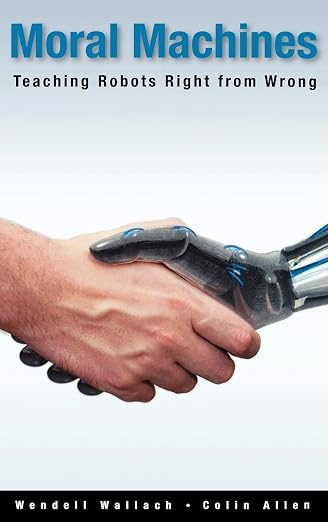
Moral Machines: Teaching Robots Right from Wrong
by Wendell Wallach (Author), Colin Allen (Author)
Publisher Oxford University Press, Publication date 12 Nov. 2008
…………………………………………………………………….

Wendell Wallach has an international reputation as an expert on the ethics and governance of emerging technologies, particularly artificial intelligence and biotechnologies.
From 2020-2024, he was Carnegie/Uehiro Senior Fellow at the Carnegie Council for Ethics in International Affairs (CCEIA)where he founded and co-directed (with Anja Kaspersen) the AI and Equality Initiative. He was a senior advisor to The Hastings Centerand a scholar at the Yale University Interdisciplinary Center for Bioethics where he chaired Technology and Ethics studies for eleven years. Wallach’s latest book, a primer on emerging technologies, is entitled, A Dangerous Master: How to keep technology from slipping beyond our control.
He co-authored(with Colin Allen) Moral Machines: Teaching Robots Right From Wrong. The World Technology Award for Ethics was awarded to Wendell in 2014 and for Journalism and Media in 2015, He was appointed Fulbright Research Chair at the University of Ottawa in 2015-2016. The World Economic Forum appointed Mr. Wallach co-chair of its Global Future Council on Technology, Values, and Policy for the 2016-2018 term.
More recently, Wallach has been referred to as the“Godfather of AI Ethics.” Over the past few years, Wallach has been developing theories of how human moral intelligence will need to be upgraded in order to successfully navigate challenges posed by climate change, AI, other emerging technologies, loss of trust in institutions, and geopolitical instability. He named these theories “tradeoff ethics” and “a silent ethics.”