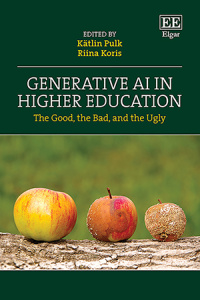
The Good, the Bad, and the Ugly: Kätlin Pulk on What Generative AI Is Really Doing to Higher Education — and What Educators Should Do About It
Q1. You and Riina Koris chose the title The Good, the Bad, and the Ugly deliberately — a framing that signals a refusal to take either the optimistic or the catastrophist position that dominates most public discourse about AI in education. What convinced you that the field needed that kind of honest, tripartite accounting rather than another book that lands clearly on one side of the debate — and what is the “ugly” dimension of generative AI in higher education that you found most consistently underexplored or avoided in the existing literature?
That is correct that the good, the bad, and the ugly in the title of our edited volume was a deliberate choice. We chose it partly to move beyond the well-established polarization around the topic, and partly to tackle the multidimensional impact technology has on education. If we view education as a multidimensional social phenomenon grounded in existing value systems and the complex relationships among social values, education, and technology, then overly optimistic or contradictory, catastrophist positions that dominate most public discourse about AI in education fall short of describing and explaining the dynamics. Being one-sided, they tend to be too narrow. Moreover, debates between these approaches often turn into an apples-and-oranges comparison.
Yes, on the one hand, we can talk about how we could and should or couldn’t and shouldn’t use generative AI. On the other hand, we also need to consider how generative AI could change us. Namely, we can talk about the instrumental impact of generative AI – efficiency gains by achieving more in less time, customization, instant availability as a personal assistant, sparring partner, tutor, mentor, etc., as reflected in Chapters 5 and 6 by Hendriksen and Kerem. There is no reason to view these opportunities as bad. Still, introducing and implementing new technology may cause some practices and skills we are reluctant to give up to perish. I really like the metaphors and the positive and negative aspects of generative AI’s impact on higher education presented by Chahna Gonsalves and Oguz A. Acar in Chapter 3. My favorite metaphor is an elevator – yes, an elevator enables fast and effortless movement between floors. The availability of elevators is very positive, especially if you are disabled, pregnant, with small children, carrying heavy bags, or wearing a pencil skirt and high heels. However, to maintain leg strength, mobility, and heart health, we need to make conscious choices about alternative activities that compensate for the extensive use of elevators and help avoid muscle atrophy. And now we have an entire industry that exists for that.
Still, technology’s impact is not limited to an instrumental level- what we gain or lose. Its impact also works at the fundamental level; that is, it changes how we relate to our environment, to other people around us, and even to ourselves. Technology alters all human relations and ways of connecting. That is, delegating some of our tasks to technology and replacing human contact with technology goes beyond instrumental aspects and touches fundamental aspects of being human. Technology impacts the way we, as humans, are. This more fundamental impact is usually less explicit than the instrumental impact, but it is still there, and because it is invisible, it may be even more critical.
Decades ago, Heidegger (1977) and Ellul (1980) argued that technology is not neutral. The emergence of generative AI calls for a fresh look at their claims about the essence of technology. For example, very recently Jaan Tallinn, the first-round investor in Anthropic, claimed in his opinion article that 10-15% of the people who working in the top AI development companies deliberately consider the cessation of human existence. So, human redundancy is one of the implicit assumptions based on how generative AI operates… at least in the 10-15% range. It is hard to say whether this 10-15% is a lot or a little, but even as a possibility, it is undeniably unpleasant. Should we treat it as a serious risk, or can we ignore it? What can we do about that? How should or shouldn’t that be reflected in our use of generative AI?
Therefore, it is vital to recognize and understand AI’s impact at both the instrumental and fundamental levels, consider related risks seriously, and design solutions to mitigate or completely eliminate unfavorable outcomes. However, this will be very challenging if one stays overly optimistic or excessively pessimistic about AI, or if one focuses only on the instrumental benefits/risks.
Q2. The book brings together an international collective of contributors presenting contrasting perspectives — from educator viewpoints to student attitudes — on AI usage in the classroom. One of the most striking things about the generative AI debate in higher education is how differently faculty and students often experience the same technology: what feels like a threat to one group frequently feels like an opportunity or a necessity to the other. What were the most surprising or challenging contrasts that emerged from bringing those perspectives together in a single volume, and where did you find genuine common ground?
Probably, the common ground in AI-related concerns and insecurities is excessive reliance on technology and its negative impact on creativity. AI’s hampering impact on students’ creativity and critical and independent thinking is one of educators’ central concerns. Clark and Denman highlight this concern in Chapter 8, where students disliked feeling overridden by generative AI.
Additionally, both students and educators tend to argue for using AI to ease their tasks while expecting genuine human effort from the other party. Generally, educators hate reading AI-created reports and projects, while students hate to follow AI-generated lectures, being evaluated by AI, and receiving only AI-produced feedback on their performance. Therefore, while technical solutions exist, both parties expect to experience the human element. Neither of the parties is willing to accept counterparty’s shortcuts.
Q3. The book includes practical guidelines and specific warnings about the uncritical use of generative AI in scientific research — a domain where the stakes of hallucination, fabricated citations, and superficial reasoning are particularly high. Can you walk us through the most important of those warnings — the failures in AI-assisted research that the contributors identified as most consequential and least visible to researchers who are enthusiastically adopting these tools without sufficient critical scrutiny?
AI-related problems in research, such as hallucination, fabricated citations, superficial reasoning, inappropriate interpretation, biased or unclean data, and non-transparent or non-rigorous data analysis, are well documented. Moreover, plausible but incorrect reasoning is also a risk. Weick (1995), in his sensemaking theory, has explained how people make sense based on plausibility, not factual accuracy. Therefore, it is easy for AI to ‘deceive’ people by providing analysis that may sound plausible but nevertheless be scientifically inaccurate or false.
Generative AI provides answers and solutions based on probability analysis. Probabilities require a set of assumptions. As mentioned earlier, technology, including various AI tools and platforms, is not neutral. Instead, it holds its implicit set of values and assumptions. Ignoring these aspects in research is unforgivable, because changing assumptions would allow different problematization, theorizing, and problem-solving.
Here, it seems appropriate to refer back to Chapter 2 by Martin and Williams. As they claim, Dreyfus grounded his criticism and skepticism about computers’ capabilities in a particular set of assumptions about how computers operate. Based on these assumptions, Dreyfus is probably still right, despite the enormous rise in computational power available today. His predictions turned out to be wrong because Big Blue operated under a different set of rules. That is, the assumptions about how Big Blue operated changed. If we ignore implicit assumptions and never question them, we can’t create anything new or provide groundbreaking solutions; we are unable to see possible or potential problems, nor possible or potential solutions to these problems, etc. We will be stuck.
In scientific research, one additional critical aspect requires our attention. Namely, research and writing scientific reports, papers, books, etc., are practices that can be considered a craft. Even when we own an original idea, not practicing writing quickly erodes our writing skills. However, somebody somewhere has said that writing is thinking. Indeed, thinking is also a practice that requires practicing continuously.
Q4. You are an Associate Professor at the Estonian Business School — a country and institution that has been notably forward-thinking about digital innovation and technology adoption. Does the Estonian context shape how you think about generative AI in higher education, and what does the perspective from a smaller, highly digitized European education system offer to this conversation that larger, more established systems might miss or be slower to recognize?
I don’t think that the Estonian context shapes how Estonians or I personally think about generative AI. I think the excitement, concerns, and a certain amount of FOMO are similar compared to other places. Also, I am not sure the Estonian education system, as such, is more digitalized. What is probably more digitalized is the education administrative system. The education itself is quite conventional, I think.
Q5. The central question your book tries to answer is: how can we ensure that reliance on AI in higher education still enables positive, proactive teaching and learning? That question implies that reliance on AI in higher education is inevitable — the debate is not whether but how. Do you believe that framing is correct, and if so, what does a higher education system that has genuinely answered that question look like in practice — in terms of curriculum design, assessment methods, faculty development, and institutional policy — compared to what most institutions are actually doing today?
I am starting to answer this question from the end. Because I don’t know exactly how most institutions handle generative AI and related issues (and probably agentic AI issues by now), I can’t make any meaningful comparison. Whether AI is inevitable in higher education is an interesting question and requires reflection on our, I would say, ontological assumptions about the essence of education, the relationship between education and technology, and the role of both in human society. A new technology promising a drastic increase in economic efficiency, a dearly held value of the existing socio-economic system, tends to be too tempting for humans to resist. AI, whether narrow, generative, or agentic, is not an exception. Higher education, a field undergoing intensive managerialization and monetization, is no exception. However, it raises the question of what counts as higher education and what it means to be educated. Is higher education an ‘end product’? Can it be acquired by knowing different AI tools and writing clear prompts that produce a polished answer to any problem or question almost instantly? Or does being educated rather mean that one has grown through the process, through various practices, à la deep reading, problematization, forming questions, defending arguments, reflection, reflexivity, human interaction, etc., and become qualitatively different in one’s abilities to understand, think, analyze, synthesize, solve problems, express oneself in writing or speech?
If generative AI is or becomes an integral part of civil society and business systems (see Chapter 12 by Mäkinen et al.), then higher education graduates should be prepared to work with it, but not only that. They should also understand what it is and its possible fundamental impact. In other words, higher education should not only train students how to use generative AI, but also how to deal with its possible social consequences – an elevator and muscle atrophy. This attempt shines through the volume’s chapters. Despite being divided into good, bad, and ugly, most authors try to offer practical solutions for addressing the potentially hazardous side of generative AI in higher education. Interestingly, in a very recent Wall Street Journal article, Allison Pohle (2026) writes that Ernst & Young’s U.S. division does not reward AI experimentation alone but promises to pay $100 million in employee rewards for demonstrating human skills like adaptability, innovation, and judgment. So, it seems the generative AI hype in business is loosening, and hopefully that helps bring attention back to enhancing human aspects in higher education curricula.
Q6. You edited this book as a scholar and educator who is clearly thinking carefully about AI’s implications for your own field. But here is a more personal question: has working on this book changed how you personally use generative AI in your own teaching and research — and is there something you discovered through the process of editing these chapters that made you more cautious, more enthusiastic, or simply more thoughtful about how you engage with these tools in your own daily academic work?
Working with the edited volume made me more cautious about the ingrained bias in generative AI models (see Chapter 10 by Margriet van Gestel and Chapter 11 by Ilia Protopapa and Bochra Idris).
Moreover, as indicated above, I consider research, writing, reading, and thinking as practices. To develop or maintain mastery of any practice, you need to keep practicing. Therefore, I can probably be considered conservative, but generative AI has not changed my research practices. Since my research is either conceptual or based on qualitative data, delegating some tasks to technology seems highly inappropriate. I am especially alert to guard my writing. I know how much effort it takes to express myself clearly and concisely. I know I am far from mastering this skill, and I know that if I delegate this practice to technology, my current skill level will deteriorate quickly. Writing prompts do not equal academic writing.
As a non-native English speaker, I am grateful for Grammarly to correct my (non)use of articles – in Estonian, which is my mother tongue, we don’t have articles. Therefore, I tend to be relatively indifferent about ‘the’ or ‘a’. At the same time, I am quite suspicious about the suggestions to reword sentences (again, see Chapter 11 by Protopapa and Idris). Apparently, my approach is not overly original, as I have acknowledged that many scholars take a similar approach to using generative AI in their research and academic writing.
Qx. Anything else you wish to add?
In general, it feels to me that the tides in higher education are turning, and because of generative AI, it tends to become much more elite than it is now. To become educated is a process. It is a process of personal growth where the good old expression ‘no pain, no gain’ still holds true. Higher education does not become less accessible and more elite because of inequality in access to the best generative AI tools. Instead, if students rely more heavily on generative AI in their coursework ‘to avoid pain’, they outsource their growth process. At the same time, these students who genuinely want to learn and become educated will earn faculty’s full attention. Put differently, higher education may, while maintaining its more-than-less mass-production form, silently turn into a master-apprentice setup.
Finally, I am happy to announce that the second updated edition of Generative AI in Higher Education: The good, the bad and the ugly, two years later, with Edward Elgar Publishing, is on its way. Stay tuned!
References
Clark, A. H., & Denman, K. (2025). “Chapter 8: Generative AI as a disrupter of creativity”. In K. Pulk and R. Koris (Eds.), Generative AI in Higher Education: The good, the bad, and the ugly. Cheltenham, UK: Edward Elgar Publishing. Retrieved Sep 6, 2026, from https://doi.org/10.4337/9781035326020.00019
Ellul, J. (1980). The Technological System. The Continuum Publishing Corporation.
Gonsalves, C., & Acar, O. A. (2025). “Chapter 3: Identifying discourses of generative AI in higher education”. In K.Pulk and R. Koris (Eds.), Generative AI in Higher Education: The good, the bad, and the ugly. Cheltenham, UK: Edward Elgar Publishing. Retrieved Sep 5, 2026, from https://doi.org/10.4337/9781035326020.00012
Heidegger, M. (1977) The question concerning technology and other essays. New York: Garland Publishing.
Hendriksen, C. (2025). “Chapter 5: Student learning in the age of AI: principles and practices for using AI in higher education”. In K.Pulk and R. Koris (Eds.), Generative AI in Higher Education: The good, the bad, and the ugly. Cheltenham, UK: Edward Elgar Publishing. Retrieved Sep 6, 2026, from https://doi.org/10.4337/9781035326020.00015
Kerem, K. (2025). “Chapter 6: Generative AI as an enabler for educators: practical tips for generative AI usage in teaching”. In K.Pulk and R. Koris (Eds.), Generative AI in Higher Education: The good, the bad, and the ugly. Cheltenham, UK: Edward Elgar Publishing. Retrieved Sep 6, 2026, from https://doi.org/10.4337/9781035326020.00016
Martin, W., & Williams, D. (2025). “Chapter 2: What ChatGPT still can’t do (but we might do with it): Hubert Dreyfus and extended-mind cyborgs”. In K.Pulk and R. Koris (Eds.), Generative AI in Higher Education: The good, the bad, and the ugly. Cheltenham, UK: Edward Elgar Publishing. Retrieved Sep 5, 2026, from https://doi.org/10.4337/9781035326020.00011
Mäkinen, J. V., Mattila, J. I., Tammilehto, M., & Varsta, R. (2025). “Chapter 12: Beyond the Friedman doctrine: contextuality, social knowledge, and professional craftsmanship in business education”. In K.Pulk and R. Koris (Eds.), Generative AI in Higher Education: The good, the bad, and the ugly. Cheltenham, UK: Edward Elgar Publishing. Retrieved Sep 6, 2026, from https://doi.org/10.4337/9781035326020.00024
Pohle, A. (2026). Ernst & Young Is Giving $100 Million in Bonuses to Staff for ‘Human’ Skills. The Wall Street Journal, August 31. Available at https://www.wsj.com/business/ernst-young-is-giving-100-million-in-bonuses-to-staff-for-human-skills-9320e93d
Protopapa, I., & Idris, B. (2025). “Chapter 11: Ethical and moral pitfalls of generative AI in academic research”. In K.Pulk and R. Koris (Eds.), Generative AI in Higher Education: The good, the bad, and the ugly. Cheltenham, UK: Edward Elgar Publishing. Retrieved Sep 6, 2026, from https://doi.org/10.4337/9781035326020.00022
Tallinn, J. (2026). Peatne jõukaim eestlane: ligi 15% AI tippfirmades töötavate inimeste eesmärk on inimeksistents lõpetada – Arvamus. Delfi, August 24. Available at: https://arvamus.delfi.ee/artikkel/120605248/peatne-joukaim-eestlane-ligi-15-ai-tippfirmades-tootavate-inimeste-eesmark-on-inimeksistents-lopetada
van Gestel, M. A. (2025). “Chapter 10: Strategies and ethical challenges for equality in generative AI research: addressing access, bias, and privacy”. In K.Pulk and R. Koris (Eds.), Generative AI in Higher Education: The good, the bad, and the ugly. Cheltenham, UK: Edward Elgar Publishing. Retrieved Sep 6, 2026, from https://doi.org/10.4337/9781035326020.00021
Weick, K. E. (1995). Sensemaking in organizations. Thousand Oaks, CA: Sage Publications.
………………………………………….

Kätlin Pulk is an Associate Professor of Organization Studies at Estonian Business School. Her research focuses on time and temporality in organizations and in organizing, organizational change, continuity, and events. She is the author of Time and Temporality in Organisations: Theory and Development (Palgrave Macmillan 2022), and a co-editor of the four anthologies: Historicity in Organization Studies: Describing Events and Actuality at the Borders of Our Present (Palgrave Macmillan 2025) together with François-Xavier de Vaujany and Pierre Labardin, Generative AI in Higher Education: The good, the bad and the ugly (Edward Elgar Publishing 2025) together with Riina Koris, The Incomplete Organization: When the Not (Yet) Matters in Organizing (Edward Elgar Publishing forthcoming) together with François-Xavier de Vaujany and Marc Lenglet, and Generative AI in Higher Education: The good, the bad and the ugly two years later(Edward Elgar Publishing forthcoming) together with Riina Koris.