Cases on Entrepreneurship and Artificial Intelligence: A conversation with Robin Bell and Scott Andrews
Q1. Your book (*) draws on case studies from four continents. What is the most profound lesson you both learned from these global examples regarding how regional infrastructure and cultural attitudes alter the way entrepreneurs adopt AI?
The first point we wanted to demonstrate was that organisational integration of AI strategies into business structures is a global phenomenon. We were keen to ensure the cases were sourced from across the world to draw attention to the global engagement of such technologies among entrepreneurial communities in all cultural contexts. The case method is a great way of showcasing the impact of cultural attitudes on entrepreneurial practices, so this became an important feature of this book, re-emphasising the oft-used phrase: ‘think globally act locally’.
The cases also illustrate how flexibly AI and related technologies were being applied across different continents to meet the diverse needs of customers and entrepreneurs. Within the book, we have a case exploring Labbaik VR, a Pakistani startup developing immersive virtual reality experiences, supported by AI, to help people learn about the Hajj and Umrah pilgrimages. This illustrates how emerging technologies can be adapted to meet particular religious and cultural needs, while also raising questions about cultural acceptance and authenticity. Another case explores how the Turkish fashion retailer LC Waikiki worked with a local AI startup to develop a digital stylist that provides personalised clothing recommendations, demonstrating the importance of understanding local consumer preferences when developing AI applications.
We also have a case examining the potential of AI to foster more inclusive entrepreneurship in sub-Saharan Africa, particularly among entrepreneurs living with disabilities in Nigeria. It explores how AI-powered accessibility tools and business applications could help overcome barriers to participation, improve access to markets and create new entrepreneurial opportunities. However, it also highlights how limited infrastructure, affordability and access to digital skills can restrict the adoption of these technologies. Together, these examples demonstrate both the remarkable flexibility of AI to address very different local needs and its potential to lower barriers to entrepreneurship. However, realising these opportunities depends on the local environment, available resources and the ability of entrepreneurs to adapt the technology to their circumstances.
Q2. When examining the moral dilemmas and regulatory considerations in the text, what critical lesson do you hope founders take away about building a business model that remains agile enough to survive shifting data privacy laws across different international jurisdictions?
There is an unavoidable need for founders to ensure they are very familiar with the legal contexts within which they are seeking to operate. As editors for this book, we were very keen to emphasise the importance of adopting a responsible AI mindset when developing their business model.
In practice, this means that ethical and regulatory considerations need to be embedded within business models from the outset, rather than treated as something to address when problems arise. Within the book, we have a case exploring Replika, an AI companion service that allows users to develop personalised relationships with AI-powered chatbots. While the technology offers opportunities to address issues such as loneliness, it also raises significant ethical questions around the collection of personal information, user vulnerability and the responsibilities of businesses developing these technologies. In 2023, concerns about the protection of minors and the handling of personal data led to intervention by the Italian data protection authority, demonstrating how regulatory challenges can directly affect a business’s operations.
For entrepreneurs seeking to expand internationally, this highlights the importance of developing business models that can adapt to different and evolving legal requirements. This includes considering how customer data is collected, stored and used, alongside the safeguards needed to protect users across different markets. However, the cases also demonstrate that responsible AI goes beyond simply meeting legal requirements. Entrepreneurs need to consider the wider ethical implications of their technologies and how these may be perceived by customers and other stakeholders. Ultimately, building trust, protecting users and retaining the flexibility to respond to changing expectations are important foundations for sustainable business growth.
Q3. Because this text provides ready-to-use teaching tools, what is the single most important operational lesson you believe business students can learn by analyzing real-world AI failures in these case studies rather than just looking at success stories?
The case method is predicated on the process of students entering into the narrative of the case text and journeying through the data in order to immerse themselves into the organisational environment described within the case, to confront issues and to place themselves into the shoes of the actors from within the case. Students don’t just read cases; a good case session enables students to ‘join in’ and in doing so they meet many sides of themselves that they can take back to their real worlds once the playing is over. With this in mind, it is essential that the student case offering comprises examples of both successful and unsuccessful ventures that provide a balanced reflection of the real world and hence equips them for the real world when pursuing their own professional endeavours.
The central lesson is that introducing AI is not simply a technological decision. Its ability to create value depends on how effectively an organisation brings together human judgement, the right skills, sound governance and an understanding of the context in which it operates.
Within the book, we have a case exploring the relationship between Aave, a decentralised finance platform, and Gauntlet, a specialist provider of AI-based risk management services. Despite the benefits of the technology, the partnership broke down, exposing the vulnerabilities that can arise when an organisation becomes heavily dependent on an external technology provider. This was not a failure of the AI technology itself, but highlighted the importance of organisational relationships, governance and managing operational risks.
Another case examines a German technology provider introducing generative AI to improve its processes during a major IT transformation project. Although the technology helped stabilise the project, it could not recover earlier delays, and its effective use depended on understanding the organisation’s specific processes, developing employee capabilities and critically evaluating AI-generated outputs.
These examples demonstrate why it is important for students to consider the organisational and human factors behind the adoption of AI, rather than focusing solely on its technical capabilities. Understanding where things have not gone as planned encourages students to think critically about the decisions, capabilities and safeguards required to implement AI successfully. Ultimately, AI is a tool that can create significant opportunities, but realising these depends on how effectively people and organisations understand, manage and apply it.
Q4. Combining the global and regulatory angles, how do the lessons curated by you both guide an entrepreneur trying to scale an AI-driven startup from a loosely regulated market into a strictly regulated global theatre?
A central lesson from the book is that successfully scaling an AI-driven business internationally requires more than simply transferring a technology or business model into a new market. Entrepreneurs need to recognise that the legal, regulatory and cultural environments in which they operate can differ significantly, and that approaches which are acceptable in one market may not be appropriate or permissible in another.
Within the book, we have a case examining dormakaba, an international company developing AI-driven access management solutions, particularly for airport environments. While AI offers opportunities to improve security and operational efficiency, its application also raises questions around the collection and use of sensitive biometric data, algorithmic bias and compliance with different regulatory requirements. Another case explores Replika, an AI companion service, which faced intervention from the Italian data protection authority over concerns about user protection and personal data. These examples highlight how regulatory and ethical considerations can directly influence how AI technologies are developed, implemented and commercially operated.
For entrepreneurs looking to expand internationally, the key lesson is to build flexibility and responsible AI practices into their business models from the outset. This means understanding the requirements of potential markets before entering them, establishing appropriate data protection and governance arrangements, and retaining the ability to adapt products and processes as regulations evolve. It also requires recognising that legal compliance alone may not be sufficient, as cultural expectations and attitudes towards privacy, technology and trust can vary between markets.
Ultimately, international growth should not simply be about scaling technology as quickly as possible, but about developing a business that can adapt to different operating environments while maintaining consistent ethical standards. Taking this approach can help entrepreneurs manage risks, build customer trust and create a stronger foundation for sustainable international growth.
Q5. When students engage with your discussion questions regarding AI employee management and organizational structure, what core takeaway or ethical mindset do you hope they develop so they don’t treat human capital purely as an optimization metric?
Responsible engagement with AI technologies provides significant opportunities to founders and to entrepreneurial organisations, often enabling some business functions to be managed quicker, more efficiently and often more accurately, which frees up greater space for the workforce to focus energies on higher level critical organisational thinking. Whilst there is no doubt that larger organisations have made staffing savings with the incorporation of AI strategies, for entrepreneurs embracing AI technologies the benefits are far more likely to be about developing and expanding new areas for growth and development rather than staff efficiency savings.
This also highlights why employees should be seen as central to the successful adoption of AI, rather than simply as a cost to be reduced. It can be tempting to evaluate AI primarily through measures such as productivity, efficiency and labour savings, but this risks overlooking the experience, creativity and judgement that people bring to an organisation.
Within the book, we have a case examining Miele, the German family-owned household appliance manufacturer, and its integration of generative AI into research and development. Rather than approaching AI adoption purely as a technological exercise, the company involved employees from different departments in identifying and evaluating potential applications. This highlights the importance of involving those who will ultimately use the technology, drawing on their knowledge and experience, and providing opportunities to develop the skills needed to work effectively alongside AI.
Another case explores how the Turkish fashion retailer LC Waikiki developed an AI-powered digital stylist in collaboration with a technology startup. As the technology became increasingly important to the business, the company faced decisions about whether to develop its own AI capabilities. These raised wider organisational questions around team structures, collaboration and how to attract specialist AI talent while maintaining fairness and cohesion among existing employees.
We would hope that students recognise that responsible AI adoption is not simply about improving organisational performance, but also about considering how technological change affects the people within an organisation. This means involving employees in decisions, investing in their development and considering how AI can complement and enhance their capabilities rather than simply replacing them. Ultimately, the greatest opportunities come from combining the capabilities of AI with human knowledge, creativity and judgement, allowing organisations and their employees to develop and grow together.
Q6. While collaborating to compile these diverse educational lessons on global markets and regulatory friction, what is a personal lesson you each learned about your own views on the future of AI in academia?
There is no doubt that AI represents a paradigm shift in organisational development. Our work in business schools brings us into regular contact with business leaders, and these conversations frequently turn to the integration of AI into business practices. Responsible engagement with AI is key to sustainable business development, so it is essential that our students are equipped with the skills, know-how and ethical mindset to positively and responsibly embrace AI in readiness for the workplace.
Editing the book has reinforced the importance of developing students’ critical judgement, rather than simply their ability to use AI tools. The cases demonstrate how the effectiveness of AI depends not only on the capabilities of the technology, but also on the people, organisations and contexts in which it is applied. This has important implications for what we teach, how we teach it and what we expect students to learn.
This perspective also builds on research by Robin and Heather Bell exploring how AI can be meaningfully integrated into entrepreneurship education. Students need to develop their understanding and capabilities progressively, starting with an appreciation of what AI can do, how it works and its limitations. They then need opportunities to apply AI within entrepreneurial activities, such as identifying opportunities, developing business ideas and supporting decision-making, while learning to critically evaluate its outputs. Ultimately, they should develop the capability to use AI confidently and responsibly in real entrepreneurial situations, recognising that human judgement and accountability remain essential.
Case-based learning is valuable in supporting this development. By examining real-world entrepreneurial challenges and stories of how AI has been applied, students can develop their understanding of its opportunities, limitations and implications. Cases encourage students to consider different perspectives, put themselves in the position of decisionmakers and critically evaluate the choices available. However, understanding how others have applied AI is only part of the learning process. We also need to provide students with opportunities to use AI themselves, applying it to practical entrepreneurial challenges, experimenting with different approaches and reflecting on the outcomes. This combination of learning from others and learning through practical application is particularly important in developing entrepreneurial capabilities.
This also challenges us to reconsider how we assess students. When AI can readily generate business ideas, plans and recommendations, the emphasis increasingly needs to be on how students question, evaluate and apply these outputs, rather than simply producing them. Ultimately, our role as educators is not just to teach students about AI, but to provide them with opportunities to develop the practical capabilities, critical thinking and entrepreneurial judgement needed to use it responsibly and effectively.
Qx. Anything else you wish to add?
AI is increasingly influencing almost every aspect of entrepreneurship and business practice, from identifying opportunities and developing new products and services to changing how businesses operate, make decisions and engage with customers. Given the breadth of its applications and the pace of its development, it is essential that future entrepreneurs understand and embrace AI, and that it becomes an integral part of business and entrepreneurship education rather than something taught as a separate or optional topic. The diversity of cases within the book helps illustrate just how widely AI is being applied across different industries and entrepreneurial contexts.
However, one of the challenges for academia is the pace at which AI is developing. New applications, capabilities and challenges are emerging so quickly that it will be increasingly difficult for educators to keep up with developments through traditional academic research and teaching materials alone. This makes maintaining strong connections with industry, and understanding how AI is actually being used in practice, more important than ever. This is not something we can teach effectively from an academic ivory tower, disconnected from the changing realities of business.
This is also why case studies and examples drawn directly from industry will become increasingly valuable. They provide a way of bringing emerging business practices and challenges into the classroom, helping educators keep their teaching current and connected to the realities of AI adoption across different industries and entrepreneurial contexts.
Ultimately, universities need to embrace AI within their curricula and continually reflect on what and how they teach. If we are not preparing students to understand, critically evaluate and work effectively with AI, we risk leaving them inadequately prepared for the entrepreneurial and business environments they will enter.
Reference
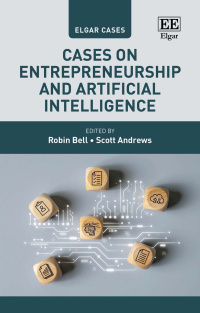
(*) Cases on Entrepreneurship and Artificial Intelligence
Edited by Robin Bell, Ph.D., Professor of Entrepreneurship and Scott Andrews, Ph.D., Head of Worcester Business School, Worcester Business School, University of Worcester, UK
Elgar Cases in Entrepreneurship Publication Date: 2026 ISBN: 978 1 03534 783 4
……………………………………………………..

Robin Bell
Robin Bell is a Professor of Entrepreneurship at the University of Worcester. He is the Programme Director for Worcester Business School’s DBA and has previously led the development of the School’s first online degree programme, and fostered new relationships as the Director of International Partnerships. Robin was previously a Visiting Associate Professor at Beijing Foreign Studies University and has advised on the development of numerous entrepreneurship education programmes and ecosystems across China.

Scott Andrews
Scott is Head of Worcester Business School and a longstanding case scholar and author. He has led over 200 international case-based programmes in more than 30 different countries. He is a Senior Fellow of the Higher Education Academy and a Chartered Manager having been awarded the Champion of the Year award by the Chartered