The Playbook for Scale: Insights on the 2026 InterSystems Impact Awards from MIT Judge Andrea Kates
The 2026 InterSystems Impact Award winners were announced at this year’s InterSystems READY global summit conference, chosen from nominees by a panel of external judges—scholars and participants in business and technological innovation—from the Massachusetts Institute of Technology (MIT). The judges looked for InterSystems client organizations and their innovations that:
- Make a significant difference.
- Break new ground (with a bonus for AI-driven vision/work).
- Set an example for others to follow.
The focus of these Awards is how clients innovate, using InterSystems technology. By highlighting transformative projects that drive positive change, the Awards foster collaboration, inspire innovation, and strengthen connections across the global InterSystems community.

Andrea Kates is one of this year’s Impact Award judges. She is Entrepreneur in Residence at the MIT Kuo Sharper Center for Prosperity and Entrepreneurship, focused on moving businesses from early stage to scale, with an emphasis on growth markets and technology. She was the CEO of the Silicon Valley-based software platform co-founded by the pioneer of Lean Startup, which commercialized innovation for more than 13,000 teams in agtech, healthcare, fintech, manufacturing, and advanced technologies. Andrea has led initiatives for Cisco, Ford, Fujitsu, Intel, Mayo Clinic, RUFORUM Africa, and Tata, and advised technology and innovation startups across five continents. Her book From Stuck to Scale diagnoses the commercialization challenge and provides an end-to-end toolset for businesses transitioning from early stage to durable scale. Andrea advises companies worldwide and serves as technical advisor to RUFORUM, the Conference Board, and the CORC Novo Nordisk Foundation CO₂ Research Center. You can learn more about her at AndreaKates.com.
Q1: What were your main takeaways from judging the 2026 InterSystems Impact Awards?
A1: The biggest eye-opener was the sheer velocity of corporate innovation over the last year. We saw companies deploy complex, interoperable systems in a single twelve-month cycle that historically would have taken twice as long to build. It really proved the massive operational leverage you get when you combine InterSystems capabilities with the power of AI advances.
I was also struck by the global, ecosystem-wide scale of these projects. We weren’t just looking at minor internal tech upgrades; these were massive overhauls in incredibly complex, highly regulated industries:
- In the Middle East and Africa, winners built the foundational data infrastructure needed to connect agile startups, multinational pharma companies, and academic researchers.
- Across Europe and the Americas, healthcare providers tackled notoriously fragmented legacy data, turning it into streamlined systems that reach underserved populations—and doing it with blueprints that other hospital networks can easily replicate.
- In global logistics, companies deployed AI-driven digital twin tech to calculate risk and speed up supply chains for everything from aerospace and automotive to luxury retail.
Debating these projects with my fellow judges, Phil Budden and Doug Williams, made one thing clear: the current wave of innovation isn’t about isolated experiments anymore. It’s about building connected ecosystems.
Q2: How did your own views on innovation and entrepreneurship shape how you judged this year’s nominees?
A2: In my book, From Stuck to Scale, I focus heavily on the tough transition from an initial innovative or entrepreneurial pilot into true, large-scale commercialization. That’s the exact lens I brought to the judging panel. I was looking for breakthroughs in actual organizational impact, scalability, and replicability.
For every nominee, I essentially asked three pragmatic questions:
- Is this delivering a measurable, first-of-its-kind result? Does the result have a broad impact?
- Can this solution thrive inside a messy, complex corporate ecosystem?
- Does it create a repeatable archetype that other leaders can follow?
The winners weren’t just great innovators—they were master scalers. They built for long-term permanence from day one.
Q3: Did you spot any specific patterns or a repeatable “playbook” among the winning innovations?
A3: Absolutely. Whether you look at Facilit Tecnologia’s data retrieval work in Latin America, Kyocera’s autonomous 24-hour libraries, Sportbot Europe’s immersive fan experiences, or the Dubai Health Authority’s secure, real-time data environment—they all used a remarkably similar playbook.
Specifically, the winners consistently executed on three things:
- They designed for interoperability from day one. They engineered robust data backbones upfront to ensure seamless information flow across different organizations.
- They focused on pragmatic, applied AI. The trend has shifted away from speculative AI experiments toward automated intelligence designed to solve specific operational bottlenecks. We saw AI used to eliminate high-friction issues, like synthesizing complex medical records or optimizing predictive demand forecasting.
- They understood that scale happens at the intersection of tech and human impact. These organizations didn’t treat innovation as just a math problem or an efficiency metric. The ultimate payoff was always human: shorter wait times for clinical procedures, friction-free public services, or highly seamless B2B collaborations.
Q4: From your perspective, how can leaders accelerate and spread innovation faster within their industries?
A4: We have to stop pitching technology and start engineering alignment. One of the biggest failure modes in corporate innovation is trying to convince stakeholders to adopt a tool based entirely on the innovator’s worldview. High-velocity scaling requires an outside-in approach. You have to look at the partners, collaborators, and internal teams whose support you need and ask: “What do they actually care about? What are their priorities, and how does our technology help them win?”
That insight is really the heart of From Stuck to Scale. Lasting innovation requires a deep understanding of what it takes to get cross-functional teams and external partners bought in.
This is exactly what we focus on at the MIT Kuo Sharper Center for Prosperity and Entrepreneurship. When you combine an entrepreneurial mindset and advanced tech with a real understanding of global market dynamics, you drastically compress the timeline from pilot to prosperity.
Q5: Where should people go to learn more about these kinds of corporate scaling frameworks?
A5: If you want rigorous, data-driven frameworks, a great place to start is the ongoing research and live case studies coming out of the MIT Kuo Sharper Center. We look closely at how deep tech, regional prosperity, and enterprise scale intersect.
At the same time, the InterSystems community is a goldmine for real-world blueprints. The actual architectures and deployment strategies shared by users at events like the READY 2026 summit offer an incredible masterclass in execution.
And if you’re looking for a step-by-step strategic playbook to diagnose and break through your own organizational growth bottlenecks, we’ve put together downloadable tools, frameworks, and assessment matrices you can find atandreakates.com.
Read a short summary here.
Take the free diagnostic here:

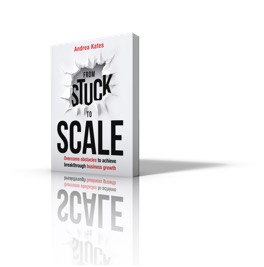
You can order From Stuck to Scale here.