Community First, Governance Second, Technology Third: Deborah Acosta on Why Smart City Initiatives Stall
Q1: You served as Chief Innovation Officer at the City of San Leandro — a mid-sized city in the San Francisco Bay Area, surrounded by some of the most intense technology innovation in the world, yet facing the very real constraints of a municipal budget, a diverse community with uneven digital access, and a political environment where innovation has to earn trust before it can scale. What is the most honest explanation you can give for why traditional smart city initiatives so often stall — not the diplomatic version, but the version you share with colleagues who are trying to understand why well-funded, technically sophisticated programs repeatedly fail to deliver lasting value for residents?
The most honest answer? We started with the technology. And even when the technology worked, I eventually learned that wasn’t enough.
I know because I was part of it. When I became San Leandro’s first Chief Innovation Officer in 2013, we had something extraordinary for a mid-sized city: Lit San Leandro, a privately built 10-gigabit fiber optic network created through a public-private partnership. It was eventually expanded to 20 miles with a $2.12 million U.S. Economic Development Administration grant, connected hundreds of businesses and nonprofits, and helped us connect every San Leandro Unified School District site at 10 gigabits. We had infrastructure that cities around the country were trying to figure out how to build.[1]
So, naturally, we asked: What can we do with it?
That question led us into smart lighting, IoT, energy systems, open data, smart-city pilots, advanced manufacturing, entrepreneurship and a citywide data platform that, in one of my presentations at the time, I actually called the “Holy Grail of Smart City Development.”
That tells you something about where our heads were.[2]
And to be fair, a lot of it worked.
Businesses and schools connected, creating expanded education and workforce development opportunities for San Leandro residents and businesses. We attracted new companies to San Leandro, often as much because of relatively affordable Bay Area rents and a strong community welcome as because of the fiber. We built relationships with manufacturers, entrepreneurs, universities and federal agencies. We created career pathways and internships for students. We experimented with new approaches to energy and civic technology. San Leandro became nationally recognized as a “smart-city” and innovation leader.[3]
So my criticism of the traditional smart-city model doesn’t come from watching it fail.
It comes from watching it succeed and discovering that successful projects do not automatically add up to community transformation.
That took me some time to understand. Interestingly, I can now see the beginnings of that realization in things I wrote while we were doing the work. In a 2014 presentation about building San Leandro’s innovation ecosystem, I wrote: “It’s about sociology, not technology.” At the time, I was thinking about the relationships required to turn our fiber investment into an innovation ecosystem. Today I think that observation goes much deeper. Technology can enable transformation. It cannot tell us what transformation a community needs.
Cities are particularly susceptible to getting this backwards. As CIO, I would frequently receive a vendor call with an exciting solution – who had no idea what the community needed. Didn’t even read our Economic Development Plan before calling. They might even bring a funding opportunity with them – without a clear vision for community benefit. A department might even have money available for that particular purpose – but it doesn’t meet community priorities.
Only later do we ask the people who are supposed to benefit whether we solved the right problem. And cities compound the problem because they are organized into departments, budgets, funding streams and political jurisdictions. People in our community are not.
A resident doesn’t experience a transportation problem on Monday, an energy problem on Tuesday and a digital-access problem on Wednesday. They experience their life. Yet we repeatedly design solutions around the way our institutions are organized rather than the way people actually live.
Then we’re surprised when a technically successful pilot doesn’t scale. The grant ends, the partners dissipate, the project champion leaves, contracts expire, another department has different priorities and claims funds needed to maintain the capital investment. The community never really owns it. That’s generally called “a failure to scale”. The kiss of death for community investments.
Increasingly, I think it is a failure to discover.
We didn’t spend enough time at the beginning understanding the problem before defining the solution: Who actually experiences it? What do they need? What already exists? Who isn’t at the table? What are the incentives of the organizations that will have to participate? Who benefits? Who bears the risk? Who will govern the system? Oy vey.
And who will pay for it after the exciting pilot money disappears?
Those questions ultimately changed how I think about innovation. Today, someone can come to me with an extraordinary AI application, a microgrid, a mobility platform, a data center, or some technology I’ve never seen before, and I will still get excited. I am inspired by the potential impact on human lives by technology. That hasn’t changed.
However, now my first question is: What problem are we trying to solve, and for whom?
That’s why our work at WeAccel now begins with Discovery, and why I’ve come to describe the order this way:
Community first. Governance second. Technology third.
Technology still matters enormously.
We just stopped letting it go first.
Q2: You helped build San Leandro’s innovation ecosystem from inside city government — a position that requires simultaneously managing the expectations of technology vendors who want to deploy, residents who want results, elected officials who want credit, and communities who have learned to be skeptical of promises. What did that experience teach you about the role of government as an innovation partner — not just a customer or a regulator — and what conditions need to exist inside a municipal organization before it can genuinely function as an engine of community-centered innovation rather than a procurement office with a rebranding problem?
Excellent question. Pondering it has clearly brought me to where WeAccel and our partners work today.
Government has enormous and compelling convening power. AND there is a catch I learned personally: A city may want innovation without actually being prepared for the behavior innovation requires.
When I became Chief Innovation Officer, City Manager Chris Zapata and Pat Kennedy, then CEO of OSIsoft and the visionary behind Lit San Leandro, both understood that my job, creating economic development based on this unique new infrastructure, could not be performed primarily from inside City Hall. I remember asking Chris for an actual percentage. How much time did he expect me to spend in the office versus out in the community?
His answer was roughly 30 percent inside, 70 percent outside. That was extraordinary permission. So, I took him seriously.
I went to technology conferences. I met entrepreneurs, manufacturers, developers, educators, researchers and investors, and brought them to San Leandro through conferences and fun events that invited the Bay Area to take a new look. Interestingly, I attended relatively few community meetings, generally because I wasn’t invited. I understand that differently today: most of the community had no idea what Lit San Leandro was or what I did. And I was not encouraged to connect.
However, I still managed to bring together community, business, utility, technology, government, investor, workforce and other stakeholders who didn’t normally sit at the same table. I looked for ideas outside government and connected them to opportunities inside San Leandro.
That’s how much of the San Leandro Innovation Ecosystem was built.
Over time, though, I learned something much less comfortable: permission from leadership does not necessarily change the culture of an institution.
I could spend an evening at a community meeting or an important technology event in San Francisco and still be questioned the next morning about why I wasn’t sitting in my office at the expected hour. That sounds like a small example. It isn’t.
Government organizations are designed to value predictability, accountability, hierarchy and clearly defined responsibilities. Those are incredibly important values. Public institutions need them.
Innovation requires some very different behaviors: going outside the organization, building relationships before you know exactly where they will lead, crossing departmental boundaries, experimenting, sharing ownership and sometimes pursuing an opportunity before there is a process for it.
Personal Observation: If you authorize those behaviors but continue rewarding and measuring only conventional ones, the institution’s immune system eventually kicks in. The municipal immune system can encircle and completely contain, if not eradicate, the innovation “virus.”
Joe Kennedy, former CEO of Pandora Internet Radio and a revered mentor, once told me that innovators see things other people can’t see. I’ve thought about that for years because it explains why innovation can be so difficult inside a bureaucracy.
Bureaucracies are necessarily built around what is already known: established responsibilities, procedures, budgets, authority and measures of performance. The innovator is being asked to see what isn’t visible yet. She’s asked to make connections that don’t yet exist, or aren’t yet obvious, and pursue possibilities whose value other people may not see.
That’s exciting when an organization talks about innovation, even codifies it in its planning documents! It can become much less comfortable when somebody actually does it.
I experienced that firsthand. I was explicitly told to spend most of my time outside City Hall, building relationships and finding opportunities. But as the work became successful and increasingly visible, I also encountered resistance from within the organization to the very behavior my job required.
That taught me something I would tell any city manager considering an innovation function today:
Don’t appoint an innovator unless you’re prepared to protect the act of innovating.
The Innovator will cross boundaries. They’ll develop relationships outside the normal chain of command. They’ll see opportunities before there is a department, budget or process for them. They may receive public attention because part of the job is telling the community’s story. And occasionally, they’ll make people uncomfortable.
If the organization responds by forcing that person back into conventional bureaucratic behavior, it hasn’t created an innovation function. It has created an innovation title.
I learned this personally: You cannot ask people to innovate without giving them the agency to do it. And you cannot give them that agency on paper while punishing them culturally for using it.
But there is one more piece. Innovation requires more than executive permission and executive protection. It requires institutional succession.
After I left San Leandro in 2018, the Chief Innovation Officer position was eliminated, and its resources were absorbed into IT. I think that’s instructive.
Innovation and information technology are related, but they aren’t the same organizational function. IT necessarily focuses heavily on operating and protecting the systems an organization already has. Innovation has to look beyond the organization, across sectors and into possibilities that don’t yet have an institutional home.
So perhaps the real test of whether government has become an innovation partner comes after the innovator is gone.
If your innovation function disappears when the innovator leaves, you built a position. You didn’t build an innovation capability.
Q3: You founded WeAccel and developed what you describe as a community-first approach to governing emerging technologies — AI, energy, mobility, communications, and Digital Public Infrastructure. That framing — governance before technology — is the inverse of how most technology deployments actually happen, where governance is retrofitted after the fact. For a CTO, CDO, or VP of Engineering at a large enterprise or a public agency who is currently building an AI deployment roadmap, what does a community-first governance approach actually require that their current planning process is almost certainly missing — and what is the cost of skipping it that they will not feel immediately but will definitely feel eventually?
I would change the premise slightly. It isn’t governance before technology.
It’s community first, governance second, technology third.
AI makes that order urgent because we are building AI into systems that already break under stress. AI doesn’t fix those systems. It inherits their design, learns from it, and scales it. That’s something we’ve been exploring directly in our work at WeAccel.[4]
So before I ask what AI can do, I want to know:
Does the system we’re putting AI into actually work for people under real conditions?
Who can’t use it? Who can’t understand it? Who gets excluded? Who handles the exception? Who can challenge a decision? Who has the authority to intervene when the system gets it wrong? Another “Oy.”
That’s why our process starts with Discovery. Not discovering what the technology can do. Discovering what people need, how they actually behave, what systems they already depend upon, where those systems fail, and what outcomes we’re trying to achieve.
Because if we get that wrong, everything that follows can be technically brilliant and still be designed for a world that doesn’t exist.
And the cost?
Eventually, you lose permission to operate.
We’ve already seen what that can look like. Sidewalk Labs’ extraordinarily ambitious smart-city project on Toronto’s waterfront became engulfed in questions about privacy, data, governance and control. People began asking a much more fundamental question:
Whose city is this?[5] []
And now we’re watching similarly fundamental questions emerge around the physical infrastructure required for AI, particularly data centers.[6]
The important point for a CTO or CDO is that none of this data may show up in the early technical metrics.
The AI may work. The pilot may succeed. Productivity may increase.
The dashboard may even be green!
And meanwhile, the people affected by the system may be discovering that they don’t understand it, weren’t considered in its design, can’t challenge its decisions, or have no meaningful agency over something that is beginning to affect their lives. That’s the delayed cost.
Trust Is Infrastructure.
Lose it, and eventually you have an operational problem, a regulatory problem, a political problem, a community problem, or all four.
And by then, you’re trying to retrofit trust into a system that may already have taught people not to trust it.
Taking the time to understand people at the beginning isn’t slowing down innovation. It can be far faster and cheaper than trying to convince them at the end.
You can win the technology argument and lose the project.
Q4. You mentioned data centers — and I want to ask about that directly, because it is a topic that sits at a genuinely uncomfortable intersection of community interest, economic development, energy consumption, and the infrastructure demands of AI. Data centers are increasingly being proposed in or near communities that are also trying to achieve energy resilience and climate goals. From your experience working at the intersection of energy, infrastructure, and community governance, what is the conversation that communities need to be having about data centers that they are currently not having — and what should public officials, technology leaders, and community advocates understand about the trade-offs before a data center agreement is signed?
I AM DELIGHTED YOU ASKED THIS QUESTION!
The first thing communities need is enough information to know what questions to ask.
That’s missing from much of the data center conversation. A data center proposal may initially come through an economic development department, and understandably, the economic development director sees investment, property development and new tax revenue. The developer explains the project and answers the questions it’s asked. Public meetings are held. The boxes for community engagement may all be checked.
But a community is not a box to check. It is an ecosystem of interests.
The resident worried about her utility bill is part of that ecosystem. So is the local business that needs reliable power, the school district, the utility, environmental advocates, labor, emergency services, nearby property owners, people concerned about water or noise, young people looking for careers, and residents who simply want to understand what this enormous piece of infrastructure will mean for the place where they live.
None of them necessarily sees the whole system. And that’s where we get into trouble.[7]
We’re seeing communities around the country begin opposing data centers only after projects are well underway. Sometimes outside organizations arrive and are characterized as “agitators” because they suddenly raise questions that weren’t being asked before.[8]
But I think we should ask a different question: Why didn’t the community know to ask those questions in the first place?
Imagine attending a public meeting about a proposed data center when you know almost nothing about data centers. Someone tells you it represents hundreds of millions or billions of dollars in investment and significant new tax revenue. There may be [unsaid: temporary] construction jobs. The developer presents a technically sound project.
What do you ask? You can’t ask about impacts you don’t know exist.
Later someone explains the potential demands on the electrical grid, water requirements, backup generation, noise, land use, tax incentives, or the relatively small number of permanent jobs some facilities may create. They may also explain opportunities the community didn’t know it could ask for: energy resilience, workforce development, infrastructure improvements, community energy assets or other lasting benefits.
Suddenly residents have very different questions. And the economic development director wonders, “Where were these people when I held the public meetings?” They may have been right there. They just didn’t yet have the information necessary to participate meaningfully.
That’s why community engagement has to be more than disclosure. It has to create agency.
And it cannot be the responsibility of any single participant to define the entire conversation. The economic development director has a legitimate interest in economic growth and tax revenue. The developer team has a legitimate interest in getting a project built and may answer quite honestly every question – they are asked. The utility sees another set of issues. Environmental advocates see others. The Mayor looks at any opportunity for economic growth.
Nobody is necessarily behaving badly.
They’re looking through different windows.
That’s why we need all of those perspectives in the room early, while there is still time for what we learn to influence the project. The purpose isn’t to manufacture consensus. People will have different interests, and some of them will conflict. The purpose is to understand the whole ecosystem well enough to ask the right questions before the major decisions have already been made.
Only then can a community ask meaningful questions about the trade-offs:
- How much power will this facility require, and where will it come from?
- What does that mean for existing customers and future community growth?
- What are the water requirements?
- What happens during an outage?
- What infrastructure must be built, and who pays for it?
- What are the real permanent employment numbers, not simply the construction jobs?
- What public incentives are involved?
- What environmental impacts remain local?
- What tax revenues actually reach the community?
And then we need to ask something communities often don’t realize they can ask:
What could we design differently?
If the data center requires major new energy infrastructure, can some of that investment also:
- improve community resilience?
- benefit surrounding neighborhoods and critical facilities?
- build workforce and educational pathways into the project?
- benefit the community through participation in the rising economic value being created rather than simply hosting the infrastructure that makes it possible?
I’m not arguing that data centers are inherently good or inherently bad. I’m arguing that a community cannot make an informed decision about a trade-off it has never been given the tools to understand.
And once an agreement has been negotiated, land-use decisions made and infrastructure commitments begun, discovering those questions becomes enormously expensive for everybody. That’s when the “outside agitators” arrive!
I would rather invite the questions in at the beginning.
Because very often, the people who appear to be opposing the project late are asking questions they should have been helped to ask early.
No one participant can see the whole system. But together, we can see more of it.
Together, WE Can Design Better.
Q5. Your work spans Community Resilience Hubs, decentralized mobility systems for seniors and people with disabilities, energy resilience, and human-centered AI — a range that reflects a systems-level view of community infrastructure that most innovation programs address in separate silos with separate budgets and separate governance structures. What have you learned about what actually enables these systems to work together in practice — the organizational, financial, and governance arrangements that allow mobility, energy, communications, and AI to be designed and operated as an integrated community resource rather than a collection of competing vendor contracts?
The first thing we’ve learned is that communities don’t experience infrastructure in silos. Government institutions, however, practice in silos.
Government has transportation programs, energy programs, emergency management, communications, housing and economic development. Each has its own funding, regulations, governance and measures of success.
But that’s not how people live.
Imagine an older adult trying to get home during a major power outage. She doesn’t have a transportation problem, followed by an energy problem, followed by a communications problem.
She has one problem: she needs to get home safely.
Her phone needs to work. Communication networks need to work. Transportation needs to be available and accessible. Someone likely wants to know where she is. Payment systems may need to function. And when the normal system fails, someone needs the information and authority to adapt so she is safe.
That’s a systems problem.
We eventually realized that instead of organizing our work around sectors, we needed to organize it around what communities need in order to function and thrive.
That led us to develop the Community Hierarchy of Needs™.
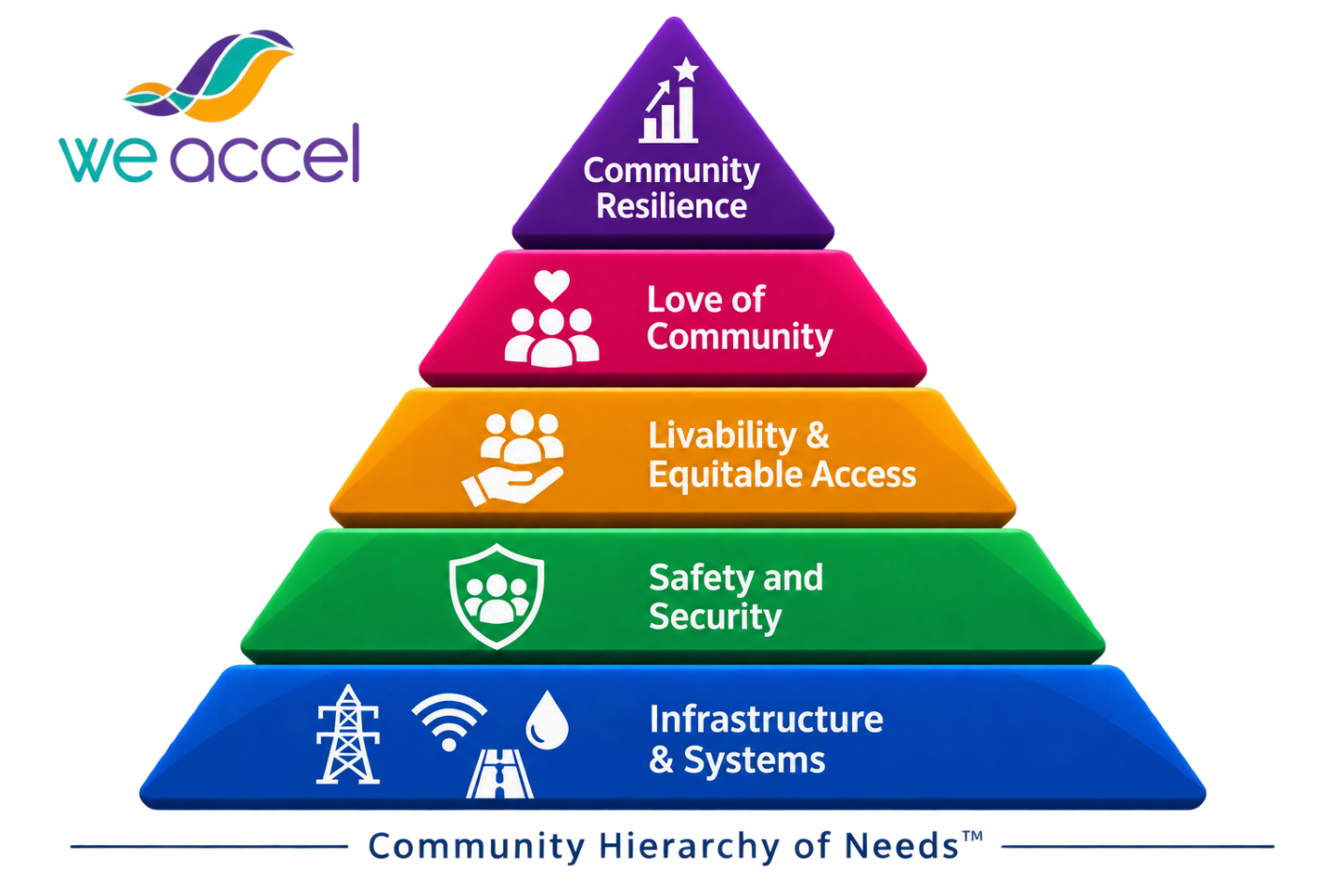
At the foundation are Infrastructure & Systems: energy, mobility, communications, water, housing and digital infrastructure. Those systems support Safety & Security, which creates the foundation for Livability & Equitable Access.
And functioning infrastructure isn’t enough to create a thriving community. Love of Community, the sense of belonging, identity, connection and trust, enables people to work together to identify and design shared community outcomes.
Ultimately, we want Community Resilience: a community with the capacity and agency to consistently and sustainably envision and shape its own future.
Our ongoing Governance Register research shows something very interesting about that hierarchy from the observations we’ve collected to date:
A striking number of the issues we’re encountering sit at Livability & Equitable Access.
People are struggling with whether they can get where they need to go, afford what they need, access services, participate fully, and trust that systems will work equitably for them. Those struggles impact a person’s ability to create positive attachment to his living environment.
It’s difficult to build Love of Community when people are still fighting to make the community function.
And Love of Community isn’t just about feeling good about where you live. It creates social capacity: relationships, trust, shared identity, communication across different interests, and ultimately the ability to solve problems together.
So we’ve discovered something of a feedback loop.
Communities need collective capacity to identify and govern their infrastructure priorities. Yet failures in infrastructure, safety and equitable access can undermine the very community cohesion needed to solve those problems collectively.
Round and around and around we go, and where we stop, nobody knows.
That’s why the levels aren’t independent. They’re interdependent.
- Energy isn’t just an energy issue. A resilient energy system can keep communications operating, transportation moving and critical facilities functioning during an emergency.
- Mobility isn’t just transportation. It determines whether people can work, receive healthcare, reach food, participate in community life and remain independent.
- Communication isn’t just broadband. It includes the myriad social, software and hardware systems humans rely on to live their lives.
And AI increasingly operates across all of them.
So the answer isn’t one giant platform, one vendor or one organization controlling everything. The goal is to integrate around the desired outcome.
That’s where Digital Public Infrastructure[9], or DPI, becomes particularly interesting to me.
DPI gives us a different way to think about the digital layer connecting these systems. Rather than every agency or provider building another closed solution, we can create shared, interoperable digital infrastructure that allows different organizations and technologies to participate while retaining their own roles and responsibilities.
THAT is the “Holy Grail of Smart Cities” that my younger CIO self-longed for – yet the technology did not yet exist. Think again about the older adult trying to get home during the blackout. We don’t need AC Transit, paratransit, emergency management, a rideshare provider, her caregiver and the power utility to become one organization. We need them to be able to coordinate around the outcome: getting her home safely.
That requires more than technology. What information needs to move between them? Who is allowed to use it? Who has authority to act? What happens when normal systems fail? How does the individual participate? Who is accountable for the outcome? ARE THESE SYSTEMS SAFE TO USE?
That’s the combination that interests me: shared outcomes, interoperable infrastructure and governance that gives each participant the agency to fulfill its role.
We’re beginning to see government funding recognize this kind of systems thinking as well. In two California Energy Commission grants our teams just won, community considerations weren’t simply added as an outreach requirement after the technology was designed. They were built into the project requirements.
For the CEC CHOIR[10] grant, the CEC required the demonstration to take place in a disadvantaged community and required projects to address specific needs and benefits for Justice communities. What excited me and my partners? Community engagement appears among the project’s performance measures, alongside technical measures for reliability, interoperability and grid performance.
Think about what that means. Community outcomes are beginning to be treated as project performance.
That’s significant. In my experience, “community engagement” has traditionally meant presenting a project to the community, collecting comments and trying to build acceptance for something largely designed elsewhere.
This is different. The community is beginning to be recognized as part of the project architecture.
The same thinking has to extend to financing. Energy resilience funding may be in one bucket, transportation in another, broadband somewhere else, emergency preparedness somewhere else, and workforce development somewhere else. Those divisions make sense to the institutions administering the money.
They make considerably less sense to the person trying to get home during the blackout.
So the starting question shouldn’t be, How do we integrate all these technologies?
[Imagine the rueful and kind smile extended to my younger self!]
It should be: What does this community need these systems to accomplish together? Once we understand the desired outcomes, we can begin aligning organizations, funding, governance, data and technology around them.
And the Community Hierarchy of Needs™ adds one more requirement: we also have to build the community’s capacity to participate in that work.
Otherwise, we can create technically integrated infrastructure without creating a community capable of governing it. No single institution sees the whole system. No single resident does either.
But together, WE can design better.
Q6. You describe yourself as a connector by nature — someone who brings together people from different sectors, disciplines, and perspectives to solve problems that no single organization can solve alone. That is a valuable and underrecognized form of leadership, particularly in the public sector where the incentives typically reward individual organizational achievement over cross-sector collaboration. Here is a personal question: in your experience working across banking, economic development, municipal government, and now community-centered innovation, what is the single most important thing you have learned about what actually makes people from fundamentally different worlds — technologists, community organizers, elected officials, utility executives, and residents — trust each other enough to build something together, rather than simply sitting in the same room and waiting for someone else to go first?
Every successful collaboration I’ve been part of had a Champion.
In 2016, I heard former Maryland Governor Martin O’Malley say something at a Global Cities Team Challenge conference that has stayed with me:
“Every mayor wants an awesome, innovative project in their city… second.”
Everyone laughed because everyone in the room knew exactly what he meant. Innovation involves risk. The outcome isn’t certain, the path isn’t obvious, and often the people who need to work together don’t even speak the same professional language. They may not even speak the same language!
Everyone may agree that something should happen, but everyone is waiting for someone else to go first.
That’s where the Champion matters.
The Champion isn’t necessarily the person with the biggest title, the budget, or even the technical expertise. It’s the person who sees what might be possible, believes in it enough to put their own credibility behind it, and starts connecting the people who can make it happen.
I’ve seen that throughout my career.
The Champion translates. She helps the technologist understand why the community organizer is objecting without dismissing that organizer as anti-technology. She helps the community understand what the utility actually can and cannot do. She recognizes that the resident who seems angry may know something about how the system really works that nobody designing it knows.
And perhaps most importantly:
The Champion makes it safer for everybody else to go second.
That’s where trust begins.
People from fundamentally different worlds usually don’t begin by trusting one another’s institutions. They trust someone.
Someone makes the introduction. Someone says, “You need to hear what she knows.” Someone creates enough safety for people to admit what they don’t know, share what they do know, and begin seeing the problem through somebody else’s eyes.
That doesn’t mean everyone agrees. Hah! Some of the most productive collaborations I’ve experienced included significant, even hot, disagreement.
Trust means we can disagree and still believe the other person belongs in the conversation.
And then, if it works, something wonderful happens. The relationships stop depending on the Champion. People start calling each other. They start solving problems together. The trust that began with one person becomes trust within the group.
That’s when you know you’ve built something rather than simply convened something.
I’ve always described myself as a connector. But I think what I’ve really been doing all these years is looking for Champions, connecting them to one another, and sometimes being willing to be one myself.
Because somebody has to go first.
And Together, WE design better.
…………………………………………………………………

Deborah Acosta is founder and CEO of WeAccel, where she works at the intersection of emerging technology, community infrastructure and governance. Previously, as the City of San Leandro’s first Chief Innovation Officer, she helped build a nationally recognized innovation ecosystem around broadband, smart-city technologies, advanced manufacturing, energy and civic innovation.
Today, Deborah brings a community-first approach to AI, energy, mobility, communications and Digital Public Infrastructure, asking not simply what technology can do, but what communities need it to accomplish. WeAccel currently participates in California Energy Commission-funded projects involving virtual power plants, vehicle-to-grid technology and community energy resilience.
A connector by nature, Deborah brings together technologists, government, industry and communities to tackle problems no single organization can solve alone.
[1] Lit San Leandro: Connecting Community Through Fiber Optics | San Leandro Next
[2] City of San Leandro, A Story of Transformation
[3] Smart 50 Award: City Wins Global Recognition for Wireless IoT Connectivity Platform / Energy Category! | San Leandro Next
[4] Designing for How People Actually Behave Under Pressure
[5] Toronto wants to kill the smart city forever
[6] $64 billion of data center projects have been blocked or delayed amid local opposition — Data Center Watch
[7] Americans Oppose AI Data Centers in Their Area
[8] Who Approved Hayward’s Largest Data Center?
[9] 2025-10-27-digital-public-infrastructure-wilkinson-et-al