

On AI and the Future of Rail Systems: Interview with Roland Edel
“AI reshapes rail jobs by reducing repetitive tasks and giving staff more responsibility for decision‑making. It also enables engineers and project teams to focus more on innovative and creative work, as well as to deliver complex rail projects on time and on budget. Technicians work increasingly data‑driven, dispatchers make better‑informed decisions, and drivers gradually move into supervisory roles for automated systems.”
Q1. As CTO of Siemens Mobility, you oversee one of the world’s most critical transportation infrastructure portfolios. When you look at the global rail industry today, where do you see AI and advanced algorithms creating the most transformative opportunities—not just for operational efficiency, but for fundamentally reimagining how rail systems serve cities and nations? What convinced you that AI was no longer optional but essential for the future of mobility?
Roland Edel: Data and Artificial Intelligence already make rail transport faster, more stable and more reliable—often without passengers even noticing. Today, AI detects early deviations in vehicles and infrastructure, analyses camera data and prevents disruptions before they materialize.
The next major step in the long run is Driverless Train Operations (DTO) with a Grade of Automation (GoA) 3 in mainline operations. In earlier projects such as BerDiBa and safe.trAIn, we developed foundational technologies that we are now applying in current projects like R2DATO and RemODtrAIn. Here, we are shaping the transition from semi‑automated operations (GoA2), including our ATO over ETCS project with S‑Bahn Hamburg, to fully automated operations (GoA4) or remote operations in stabling areas.
This requires close integration of onboard intelligence, sensors, digital infrastructure and signalling. These technologies lay the foundation for a system that can scale reliably even as demand grows.
For me, the turning point in our automation projects came when data on optimized train planning and energy savings made one thing unmistakably clear: analytics, algorithms and AI deliver tangible operational benefits—from more efficient planning to reduced energy consumption and more stable performance.
Q2. Many industries struggle to move AI initiatives from successful pilot programs to enterprise‑wide implementation. Rail systems are particularly complex—they involve safety‑critical operations, legacy infrastructure, multiple stakeholders, and regulatory frameworks that prioritize reliability above all else. What have been the biggest organizational and operational challenges you’ve encountered in scaling AI applications across Siemens Mobility’s rail portfolio, and how have you approached the tension between innovation and the rail industry’s paramount focus on safety?
Roland Edel: Scaling AI in the rail domain works only if we are able to incorporate safety‑critical functions into our innovations. Safety logic remains deterministic and certified; AI is added only where it is fully verifiable. Deployment follows a stepwise approach: first in depots, then in shunting areas, and later on the mainline.
Projects such as AutomatedTrain and others, in which we collaborate closely with an ecosystem of external partners, demonstrate how essential robust error detection and sensor fusion are for ensuring safe perception in open environments. At the same time, modern tools allow us to update safety‑relevant software during ongoing operations, keeping systems updated without compromising availability.
This combination—clear boundaries, strong diagnostics and incremental rollout—has proven to be the right way to balance innovation with the industry’s uncompromising safety culture. Finally, it all comes down to people: we can only scale AI when we train our employees accordingly and embed data and AI into all our processes.
Q3. AI is only as good as the data it learns from. Rail systems generate enormous amounts of operational data, but often in silos. From a leadership perspective, what does it take to build the data infrastructure that makes AI in rail reliable? How do you convince diverse stakeholders to share and standardize data?
Roland Edel: Trustworthy AI requires trustworthy data across the entire lifecycle of a rail system. That is why we increasingly rely on digital twins that connect design, engineering, manufacturing, operations and servicing. From the first CAD model to condition‑based maintenance and real‑time operations, a digital twin ensures that data remains consistent, interoperable and available wherever it is needed.
Open interfaces, standardized data models and federated platforms make this possible in practice. Our Railigent X suite plays a central role by integrating engineering data, vehicle data, infrastructure information and operational insights, while keeping operators in full control of their data.
When lifecycle data becomes interoperable, system availability improves, analytics become more precise, and the entire network operates more reliably and economically. And this is where stakeholders become convinced: when real projects demonstrate better services, higher reliability, improved cost structures and full data sovereignty. Once these benefits are visible, data collaboration stops being a hurdle and becomes an accelerator for innovation.
Q4. Predictive maintenance is often cited as AI’s ‘killer application.’ What is the realistic business case, and what has surprised you most about what it takes to make it work?
Roland Edel: Predictive maintenance delivers measurable business value: higher availability, reduced lifecycle costs and more efficient maintenance planning. AI uncovers patterns that humans cannot detect and enables precisely timed interventions.
What surprised me most was that cultural change often matters more than the algorithms themselves. Teams need to take into account the predictions, understand their implications and adapt work processes accordingly. Financially, the payoff is significant but requires patience—it is a long‑term investment.
The next step is what we call Predictive Availability, where entire functional chains—not just single components—remain stable. This includes linking data from incident reports, diagnostics, measurements, visual inspections and operational context into one lifecycle digital twin. This system understanding allows AI to anticipate disruptions earlier and more reliably.
The approach works well already, but its full potential depends on even closer collaboration across the ecosystem.
Q5. The rail industry is exploring different levels of automation. What framework do you use to decide what to automate first, and how do you balance safety, public trust and workforce concerns?
Roland Edel: We automate according to a clear framework: start where the environment is controlled and the benefits are greatest. Depots are ideal—they offer structured, repeatable processes with high potential for efficiency gains. Automation then moves to stabling and shunting yards, supported by AI‑driven obstacle detection and remote operation. From there, automation can be extended progressively.
At the same time, the human role remains central. Rare, complex edge cases are still best handled by experienced staff, so automation supports people rather than replaces them. Public trust grows when the benefits are transparent, greater safety, greater punctuality, fewer routine tasks, and when rollout is gradual. Each phase builds experience and confidence for the next.
Q6. Rail is already energy efficient. How big is AI’s role in sustainability, and how do you manage trade-offs?
Roland Edel: AI is one of the strongest levers for energy efficiency in rail transport. Automated driving profiles reduce energy consumption, maximize regenerative braking and minimize wear. AI‑based timetable optimization smooths traffic flows and prevents unnecessary stop‑and‑go patterns. To unlock these benefits across the entire network, data from vehicles, infrastructure and operations must be integrated. That is why we have introduced Siemens Xcelerator principles across our portfolio—Railigent X, Signaling X and the Mobility Software Suite X—to create modular cloud‑based software, interoperable APIs and an open ecosystem. Trade‑offs between energy efficiency and service frequency can be managed intelligently: AI enables the optimization of both simultaneously by balancing demand, capacity and operational constraints in real time.
Q7. AI and automation raise important questions about the future of work in rail. How do you approach workforce concerns, and what skills will be needed?
Roland Edel: AI reshapes rail jobs by reducing repetitive tasks and giving staff more responsibility for decision‑making. It also enables engineers and project teams to focus more on innovative and creative work, as well as to deliver complex rail projects on time and on budget. Technicians work increasingly data‑driven, dispatchers make better‑informed decisions, and drivers gradually move into supervisory roles for automated systems.
To support this shift, we invest in targeted training: digital learning platforms, simulation environments and hands‑on programs that build confidence in new tools. AI does not eliminate jobs; it modernizes them, creating more attractive, safer roles with clearer career perspectives.
Q8. Rail is heavily regulated. How do you work with regulators to build confidence in AI, and how do you earn public trust?
Roland Edel: Regulators are rightly accustomed to deterministic, fully explainable systems. We therefore involve them early—long before an AI‑based function enters the approval process. Together with our partner ecosystem, we develop methods to make AI systems traceable, testable and auditable, including virtual testbeds, robust perception validation and hybrid architectures that ensure safety‑critical logic remains reliable and predictable.
The overall system must remain predictable, and every AI‑supported decision must stay within defined boundaries. Continuous monitoring is essential: sensors and algorithms must detect when they deviate from expected performance and transition into safe states. Public trust grows through transparency, real‑world performance and a phased introduction—starting in controlled environments like depots and only later in passenger service.
Q9. Looking ahead to 2030, what does a realistic AI‑enabled rail system look like? And what challenges keep you up at night?
Roland Edel: By 2030, AI will be an almost invisible yet essential part of rail operations. Passengers will benefit from more reliable services, clearer information and smoother journeys. Data and AI will also enable highly personalized mobility services—from multimodal Mobility‑as‑a‑Service offerings to AI‑powered travel companions that proactively guide passengers throughout their journey.
Operators will rely on cloud‑based signaling, automated depots, predictive maintenance and digital supply chains. The system will become more resilient, flexible and climate‑friendly, and new applications will emerge. Three challenges remain. First, regulation and standards must evolve quickly enough to keep pace with innovation while maintaining safety. Second, the industry needs broader data and architecture harmonization across operators, suppliers and infrastructure owners. Third, workforce transformation must accelerate to align skills with new technologies.
To shape the Data & AI transformation in rail, we must open our data and platforms, modularize software, build digital twins and trustworthy industrial AI, strengthen ecosystem partnerships and accelerate deployment with confidence and purpose.
………………………………………………………………………………………………………
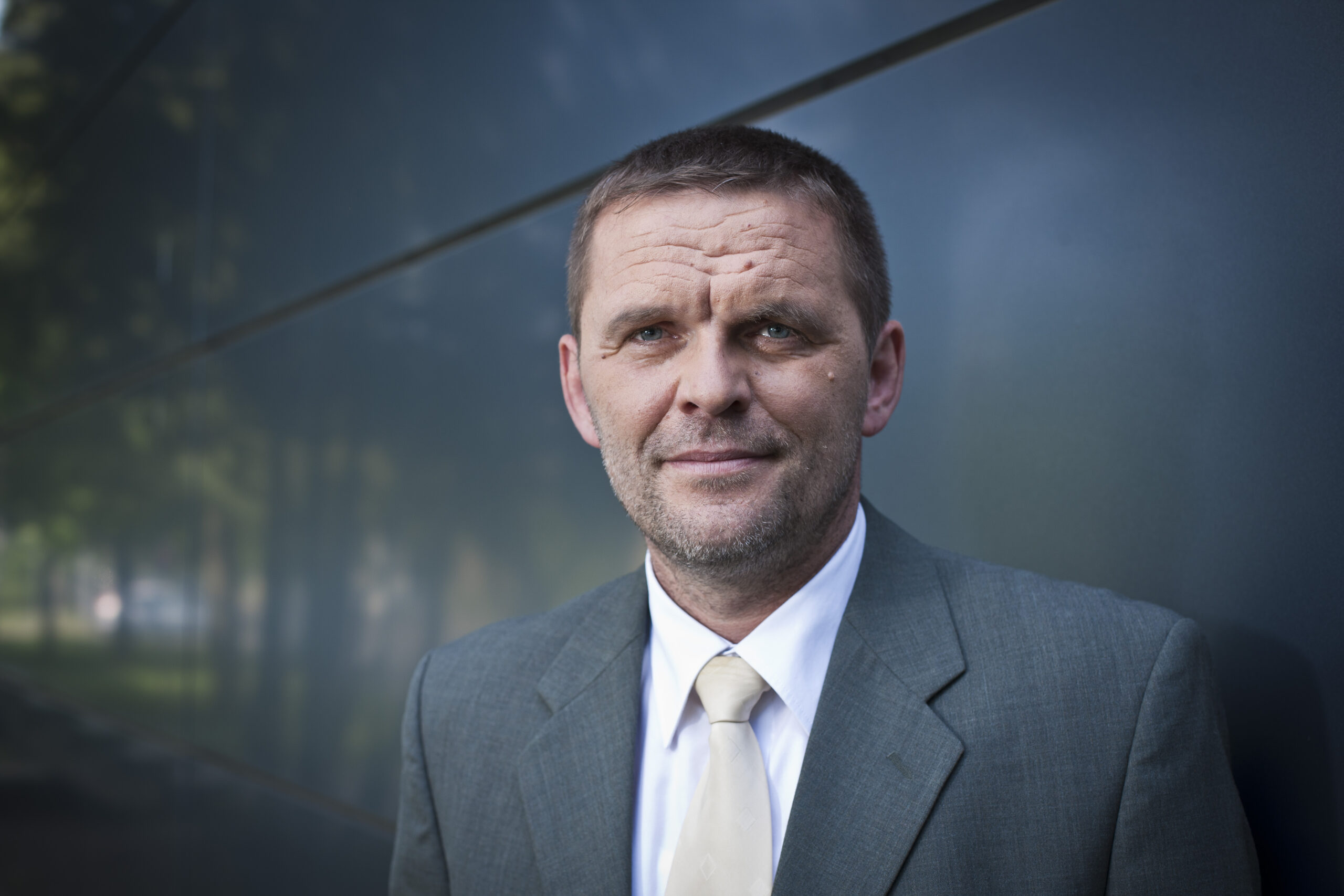
Roland Edel has been Chief Technology Officer and Head of Technology & Innovation at Siemens AG’s Mobility & Logistics Division in Munich since 2011. Since October 2014 the Division is conducted under the name Mobility.
After joining Siemens AG in Erlangen in 1993 as a design and development engineer at Transportation Systems, Roland Edel went on to assume various managerial roles within the former Electrification Division between 1996 and 2003. From 2003 onwards he was responsible for Engineering, Development and Product Management within the Business Unit Rail Electrification for five years. Roland Edel subsequently took charge of engineering and development within the newly formed Business Unit Turnkey, Electrification and Transrapid in Erlangen, before moving on to assume the position of Chief Technology Officer and Head of Innovative Mobility Solutions in the Business Unit Complete Transportation in 2009.
Resources:
– Digital Transformation for Rail, Siemens Mobility.
……………………………..
