On Semantic RAG. Q&A with Imran Chaudhri
Q1. Imran, one of the most compelling promises of Semantic RAG with Progressive Graphs is improved accuracy and reduced risk in AI systems. Can you walk us through how this approach delivers on these benefits, and share an example where you’ve seen this make a critical difference in a production environment?
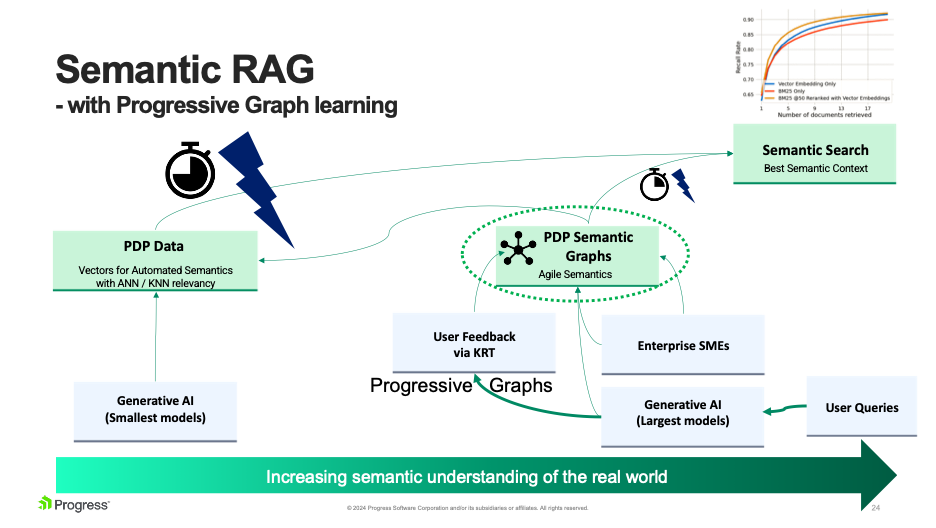
Progressive Graphs with Semantic RAG deliver improved accuracy through validated semantic enrichment. Real-world results show dramatic improvements: a Big 4 firm increased accuracy from 70% to 95%, a pharmaceutical company went from 80% to 98%, and financial 10-Q analysis jumped from 48% (vector-only) to 90% with progressive graphs. The approach combines AI-generated semantics with human validation through SMEs, reducing hallucinations while providing transparency through citations and source links. This human-in-the-loop validation ensures reliable answers in production thereby reducing risk. This solution is particularly critical in regulated industries and any customer facing use cases.
Q2. Trust is essential when deploying AI in enterprise settings, especially in healthcare, pharma, and life sciences. How do Progressive Graphs specifically help build that trust with end users and stakeholders, and what role do features like citations and links to source graphs play in this?
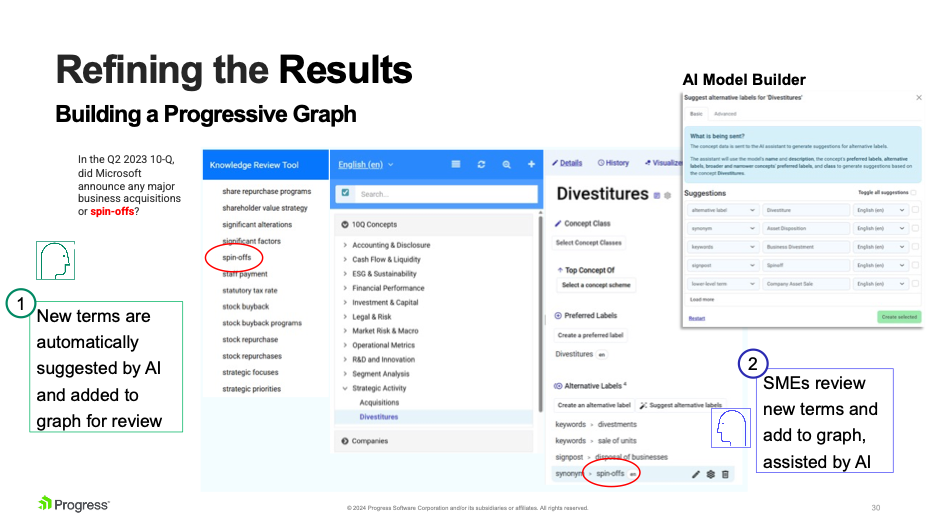
Progressive Graphs build trust through comprehensive transparency and validation capabilities. Users can trace answers back to both source documents and the semantic graphs that drove the retrieval, creating human-readable audit trails required in regulated environments. The Knowledge Review Tool (KRT) allows stakeholders to visually inspect how concepts connect and validate the semantic relationships. This transparency enables debugging, governance tracking (lineage and provenance), and role-based security enforcement. In healthcare and pharma where explainability is paramount, stakeholders can verify exactly which knowledge informed each AI response, transforming black-box AI into accountable auditable systems.
A key aspect to the trust Progressive Graphs bring is that they can be configured for a specific deployment of an application. Instead of depending entirely on ontologies that claim to represent an entire industry, graphs can be built around the terminologies used by the creators and users of that application. This allows answers to be more targeted and focused.
Q3. Many organizations struggle to move AI applications from pilot to production. What is it about Semantic RAG and Progressive Graphs that makes systems more production-ready compared to traditional approaches, and what does a realistic path to production typically look like?
Semantic RAG with Progressive Graphs accelerates production readiness through proven production deployments. A Global Chemical Company went into production “in weeks,” demonstrating rapid implementation. The approach addresses Gartner’s identified failure points—data quality, risk controls, costs, and business value—through validated semantics, human oversight, cost reduction (2-10x depending on usage), and measurable accuracy improvements. The architecture supports enterprise security domains, real-time data updates, and role-based access control. Production path involves ingesting content, establishing initial semantic graphs (potentially AI-assisted), implementing progressive learning from usage patterns, and iterative SME refinement.
Q4. Progressive Graphs adapt based on usage patterns and help discover missing data within your graph. Can you explain how this progressive learning capability works in practice, and how it contributes to both accuracy improvements and risk reduction over time?
Progressive Graphs learn by monitoring system usage patterns to identify gaps in enterprise knowledge. When users ask questions or AI agents perform tasks, the system’s configured AI automatically proposes new concepts and synonyms based on query terms not well-covered in existing graphs. Subject Matter Experts then rapidly validate, accept with placement, or reject these AI-generated candidates through the Knowledge Review Tool. Think “Spotify feedback” for corporate semantic knowledge. One customer example: 100 questions generated 55 accepted new concepts and 150 new synonyms (rejecting 195 suggestions). This reduces noise versus AI-only approaches while continuously improving semantic coverage, directly enhancing accuracy and reducing risk over time. The semantic layer is being created and updated at the “speed of business” thereby keeping the production systems relevant to the users’ or AI agents’ constantly changing business needs.
Q5. Every technology has its limitations and trade-offs. What are the key limitations or challenges organizations should be aware of when implementing Semantic RAG with Progressive Graphs, and in what scenarios might a different approach be more appropriate?
Key limitations include the need for initial semantic model development, requirement for SME involvement in validation, and learning curve for knowledge management practices. Organizations need resources for ongoing graph curation—though progressive features reduce this burden, highly-efficient human oversight remains essential. The approach works best when semantic relationships meaningfully improve retrieval (structured enterprise content) versus purely unstructured conversational data. Different approaches may suit scenarios requiring zero setup time or lacking domain expertise availability. Cost-benefit analysis should consider SME time investment versus accuracy gains.
Q6. Can you summarize how Semantic RAG with Progressive Graphs enhances regular genAI solutions?
1. Learns continuously – multi-model, in production, with no retraining ever
2. Reasons causally – understands why, not just what sounds right
3. Adapts – handles changes with human expertise
4. Compounds capability through use – gets better every time it is used
5. Persists memory without confabulations – remembers facts without hallucinations
………………………………………………………..

Imran Chaudhri, Chief Architect genAI, AI, Healthcare & Life Sciences, Progress Software
At Progress, Imran focuses on enterprise quality genAI and NoSQL solutions for managing large diverse data integrations and analytics to the healthcare and life sciences enterprise. Imran co-founded Apixio with the vision of solving the clinical data overload problem and has been developing a HIPAA compliant clinical AI big data analytics platform.
Sponsored by Progress